
Séjours & Hôtels à Fez
Découvrez les meilleures offres d’hôtels et séjours tout compris à Fez, sélectionnées par nos experts pour des vacances inoubliables.
Fez
Fez: Morocco's Cultural and Spiritual Heart
Nestled in a valley surrounded by olive groves and rolling hills in the country's northeast, Fez (Fès) stands as Morocco's oldest imperial city and its cultural and spiritual heart. Founded in the 8th century and reaching its zenith during the 13th and 14th centuries under Marinid rule, Fez has maintained its status as Morocco's intellectual and artistic capital across the centuries. The city offers visitors an unparalleled journey into Morocco's medieval past, with its UNESCO World Heritage-listed medina representing the world's largest car-free urban area and one of the best-preserved historical cities in the Islamic world.
The heart of Fez is undoubtedly Fez el-Bali (Old Fez), a mesmerizing labyrinth of more than 9,000 narrow derbs winding between ancient buildings that seem frozen in time. Unlike many historical districts that have been transformed primarily for tourism, Fez el-Bali remains a living, working city where approximately 156,000 residents continue traditions established centuries ago. This medieval urban ecosystem functions much as it did in the past, with distinct quarters for different trades traditionally arranged according to their activities. Prestigious crafts such as perfumery and bookselling were historically located near religious sites, while more pungent activities, including tanneries and pottery kilns, operated farther away.
The city's most iconic landmark is the Qarawiyyin Mosque and University, founded in 859 CE by Fatima al-Fihri, the daughter of a wealthy merchant. Recognized as one of the world's oldest continuously operating institutions of higher learning, this historic center of knowledge played a pivotal role in the transmission of learning across the Islamic world and beyond. While access to the mosque itself is restricted to Muslims, visitors can admire parts of its architecture from designated viewpoints and explore the historic library, which houses precious manuscripts, including texts dating back centuries. The institution's influence helped shape Fez into a major center of learning where subjects ranging from theology and law to medicine, astronomy, and mathematics flourished under successive dynasties.
The distinctive sensory experience of Fez el-Bali is an essential part of the city's character. The medina engages all five senses: the visual splendor of intricate architectural details and colorful merchandise; the sounds of merchants' calls, craftsmen's tools, and the muezzin's call to prayer; the aromas of spices, freshly baked bread, and street food; the texture of handcrafted leather, ceramics, and textiles; and the taste of local culinary specialties served in hidden restaurants and street-side stalls. Perhaps the most famous sensory landmark is the Chouara Tannery, one of the city's historic tanneries, where traditional leatherworking techniques continue to be practiced. From terraces overlooking the open-air workshop, visitors can observe tanners treating hides in stone vats filled with natural dyes and other materials, offering a remarkable glimpse into traditional craftsmanship.
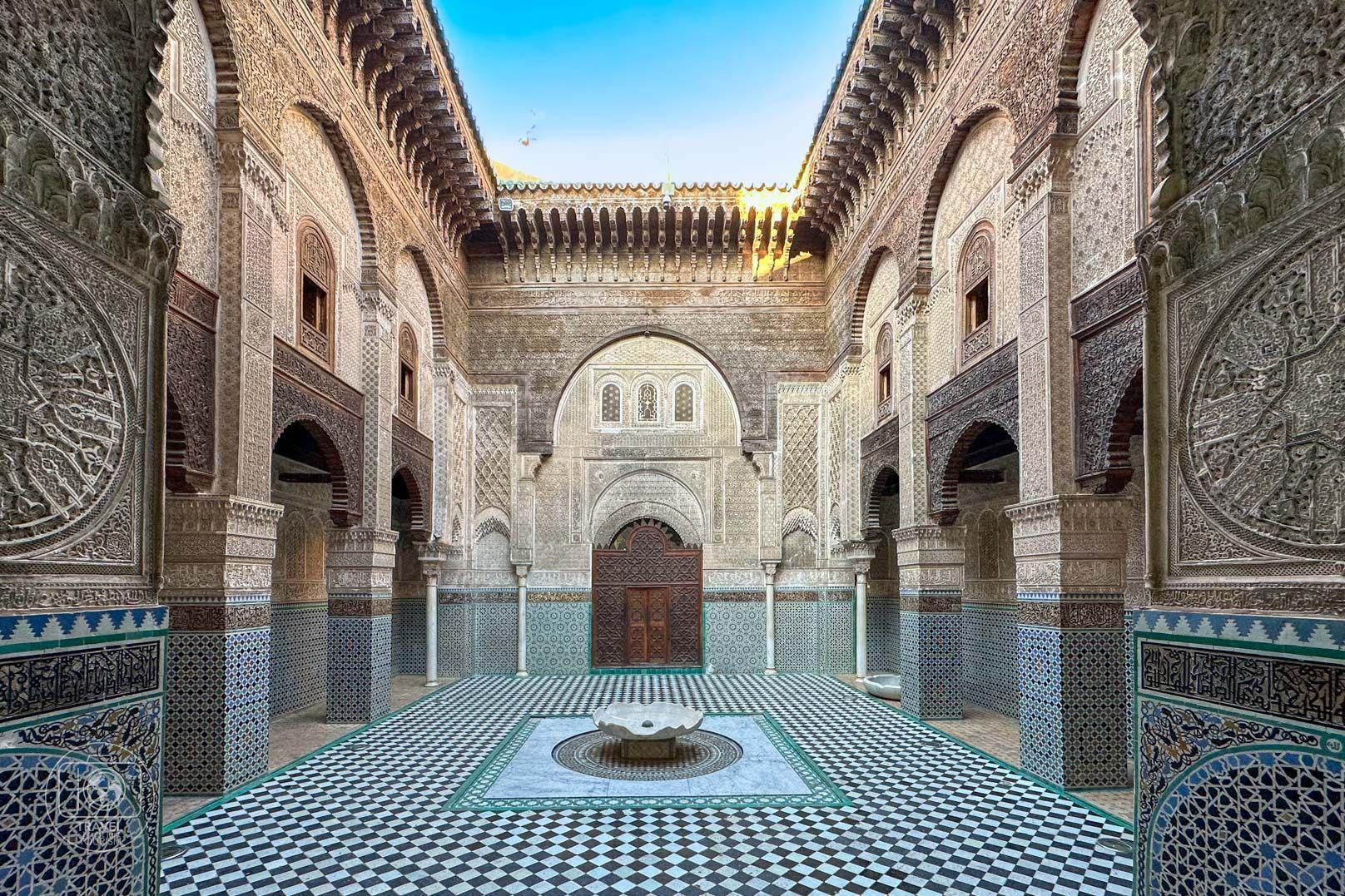
Fez's architectural treasures reflect its historical importance and cultural refinement. The city contains numerous madrasas built during the Marinid era, showcasing the sophistication of Moroccan craftsmanship. The Bou Inania Madrasa, completed in 1355, is one of the most spectacular examples, with an exquisite courtyard featuring cedar carvings, delicate stucco decoration, and intricate zellij mosaic tilework. The Al-Attarine Madrasa, located near the perfume and spice market, displays similar artistic virtuosity on a smaller scale. Beyond these educational institutions, Fez contains hundreds of fondouks, traditional merchant inns built around central courtyards, as well as hammams and thousands of private residences, many featuring hidden riads with interior gardens that offer peaceful retreats from the bustling streets.
Beyond Fez el-Bali lies Fez el-Jdid (New Fez), which, despite its name, dates back to the 13th century. This district contains the Royal Palace with its imposing brass doors, the historic mellah or Jewish quarter, known for its distinctive architecture, wrought-iron balconies, and windows overlooking the streets, and the Dar Batha Museum, housed in a 19th-century palace and dedicated to traditional Moroccan arts including ceramics, woodcarving, and textiles. The newest section of the city, Ville Nouvelle, was developed during the French Protectorate period (1912-1956) and features wide boulevards, modern amenities, and administrative buildings that create a striking contrast with the medieval quarters.
The culinary heritage of Fez reflects its long history as one of Morocco's most sophisticated urban centers. The city is famous for elaborate dishes requiring extensive preparation, including pastilla, a sweet-savory pie traditionally made with pigeon and now often prepared with chicken or seafood, as well as tagines featuring distinctive combinations of fruits, spices, and meats. Traditional breads and delicate pastries also form an important part of the local culinary culture. Fez's location in a fertile agricultural region provides abundant fresh ingredients, while its historical connections encouraged the adoption of spices, ingredients, and techniques from across the Mediterranean and beyond. Today, cooking schools allow visitors to discover the secrets of this refined culinary tradition alongside local chefs.
Fez's artistic and craft traditions remain among the most vibrant in Morocco. The city is particularly renowned for its ceramics, often featuring the distinctive blue and white palette associated with Fez pottery. Other flourishing crafts include metalwork, particularly in brass and copper, woodcarving, leatherwork, and textile production. These traditional industries are not maintained solely as tourist attractions but continue to serve practical purposes in Moroccan society, with local families purchasing household objects, furniture, and clothing from many of the same workshops that serve visitors. A new generation of designers is also reinterpreting traditional crafts for contemporary markets, helping preserve their relevance in a changing world.
The spiritual dimension of Fez is deeply woven into the city's identity. As one of Morocco's great spiritual centers, Fez contains hundreds of mosques and religious sites, with the call to prayer creating a distinctive rhythm throughout daily life. The city has also long been associated with Sufism, the mystical dimension of Islam. Numerous zawiyas, or Sufi lodges, are scattered throughout the city, some containing the tombs of revered spiritual figures who continue to attract visitors and pilgrims. This spiritual heritage also finds expression in the annual Festival of World Sacred Music, which brings together performers from diverse religious and cultural traditions in a celebration of music and spiritual expression.
Despite its profound historical character, contemporary Fez continues to balance tradition and modernization. Restoration projects throughout the medina aim to preserve its architectural heritage while improving infrastructure and living conditions for residents. Cultural initiatives such as the Fez Festival of World Sacred Music and culinary events reinforce the city's role as a center for cultural exchange. Modern educational institutions continue Fez's long intellectual tradition alongside the historic legacy of Qarawiyyin. This approach ensures that Fez remains not simply a preserved historical monument, but a living city where past and present continue to interact.
agency.noHotelsFound
agency.noContractedHotels